Lecture 8
Presenter
- Name: Katherine Jijo
- Topic: Autonomous Agents and System-Centric AI
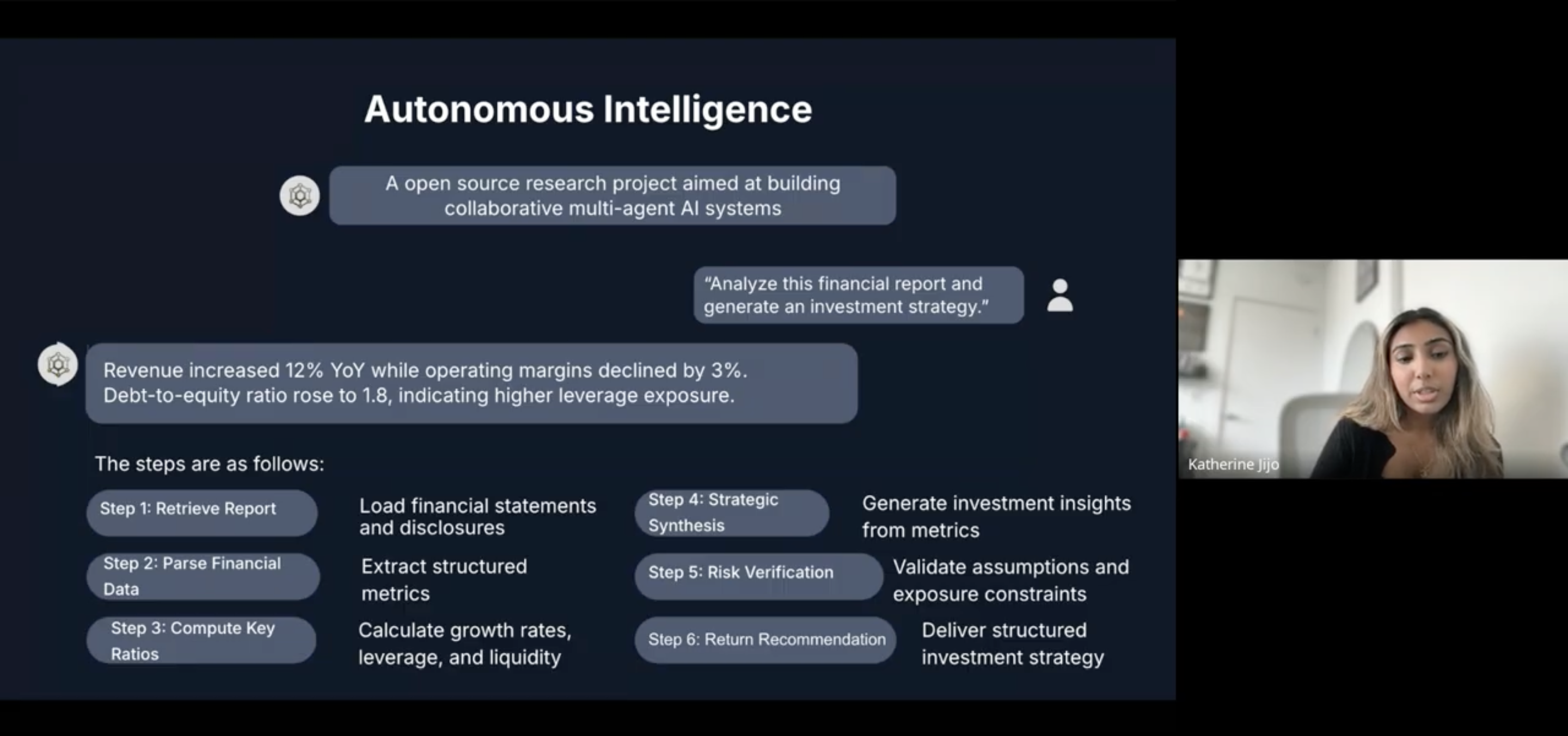
- Description: In this lecture, Katherine Jijo presents a foundational perspective on autonomous agents, defining them as a paradigm shift from model-centric to system-centric AI. Rather than focusing on individual models and prediction accuracy, she emphasizes the importance of building integrated systems that prioritize action, execution, and real-world outcomes. Katherine explains that autonomous intelligence requires designing end-to-end architectures that combine specialized agents, structured communication protocols, and a centralized orchestrator responsible for coordination, planning, and monitoring. The session explores how multi-agent systems operate collaboratively, where each agent is responsible for specific tasks such as perception, reasoning, planning, or execution. She also discusses the importance of continuous experimentation and iteration in developing effective agentic workflows, highlighting how research and testing are critical to identifying the best techniques for deployment in real-world environments. Through both conceptual frameworks and applied insights, the lecture connects these ideas to modern industry workflows and demonstrates how autonomous intelligence is shaping the future of AI-driven products and decision-making systems.
Recording
Key Takeaways
- Autonomous agents represent a shift from model-level optimization to system-level design focused on action and execution.
- Multi-agent architectures require specialized agents, structured communication, and an orchestrator to coordinate complex workflows.
- Evaluation of agentic systems should focus on system metrics such as task completion, reliability, and failure recovery rather than only model accuracy.
- Continuous experimentation and applied research are critical for integrating agentic techniques into production environments.
- Skills developed in human-centered AI and experimentation transfer directly to real-world data science and product roles, especially in agentic system development.